



As India steps into 2026, the Supreme Court faces a year that could profoundly reshape constitutional law and everyday justice. At the helm is Chief Justice Surya Kant, the 53rd person to hold India’s highest judicial office, who took oath in November 2025 with a 14-month tenure stretching until February 2027. His leadership arrives at a critical juncture when the judiciary must balance delivering constitutional clarity while repairing a justice system burdened by crushing delays and eroding public trust.
The Challenge: A Court at a Crossroads
The scale of the challenge is staggering. Over 90,000 cases currently languish in the Supreme Court alone, with millions more pending across High Courts and district courts. Among these are critical Constitution Bench matters involving seven- and nine-judge panels that have remained dormant for years, creating legal uncertainty that ripples through the entire judicial system.
But the crisis extends beyond numbers. The Supreme Court enters 2026 in what observers describe as a sharply polarized political moment, tasked with adjudicating landmark cases on electoral integrity, personal liberty, religious freedom, and free speech, all while navigating public skepticism about judicial independence and institutional credibility.
CJI Kant’s Vision: Reform with Indian Roots
Justice Surya Kant’s journey from Petwar village in Hisar, Haryana, to the apex of India’s judiciary embodies a story of merit and perseverance. The son of a Sanskrit teacher, he rose through the ranks to become Haryana’s youngest Advocate General at 38 and was designated Senior Advocate at 39. His elevation to the Supreme Court in May 2019 followed distinguished service at the Punjab and Haryana High Court and as Chief Justice of Himachal Pradesh High Court.
What sets CJI Kant apart is his emphasis on what he terms “swadeshi jurisprudence”, an indigenous judicial philosophy that draws primarily from India’s own constitutional precedents rather than borrowing extensively from foreign legal systems. After seven decades of constitutional adjudication, he argues, India has developed a self-sustaining corpus of law that should guide future decisions.
His priorities are clear and ambitious:
Pendency Reduction: Recognizing that delayed justice destabilizes democracy, CJI Kant has promised a pan-India arrears audit, clustering of similar cases, and a dedicated calendar for the oldest matters. He specifically aims to restart nine-judge bench proceedings, beginning as early as January 2026, to resolve constitutional questions that have frozen progress in lower courts.
Mediation and Alternative Dispute Resolution: His flagship initiative, “Mediation for the Nation,” seeks to resolve conflicts before they become protracted legal battles. He’s championed the establishment of ADR infrastructure, recently laying the foundation for an ADR building at Patna High Court, calling mediation a potential “game changer” for India’s overburdened courts.
Technological Transformation: Plans include a national AI-enabled case management system inspired by global best practices, coupled with technology-enabled hearings designed to democratize access to justice. However, he’s emphasized that digital justice must not exclude the poor, elderly, or digitally illiterate.
Judicial Uniformity: CJI Kant has advocated for a uniform judicial policy to address the divergence in decision-making across different courts. He compares judicial pronouncements to musical notes that should possess the same rhythm rather than sounding discordant, prioritizing predictability in how similar cases are decided.
The 2026 Docket: Cases That Could Reshape India
Several landmark matters await CJI Kant’s attention in 2026, each touching fundamental questions of rights and governance:
Electoral Integrity: Challenges to the Special Summary Revision of electoral rolls have emerged from multiple states, with petitioners alleging that names have disappeared from voter lists without notice. Migrant workers and elderly voters have discovered too late that their democratic voice has been erased. The Supreme Court must decide whether the process of cleaning voter lists has crossed into disenfranchisement, potentially setting nationwide standards for electoral roll management.
Personal Liberty and Bail: As India adjusts to new criminal laws, multiple petitions challenge expanded police powers, arrest procedures, and bail standards. The court has repeatedly affirmed that bail should be the rule and jail the exception, especially for undertrials who spend years imprisoned without conviction. Clearer guidance from the Supreme Court could mean the difference between freedom and prolonged incarceration for thousands.
Religious Personal Law: Pending challenges to practices like nikah halala and polygamy ask whether dignity and equality can coexist with long-standing personal law traditions. These cases have remained pending for years, reflecting judicial caution around deeply sensitive social questions. Any ruling in 2026 will signal how the Constitution negotiates its promise of equality with claims of religious freedom.
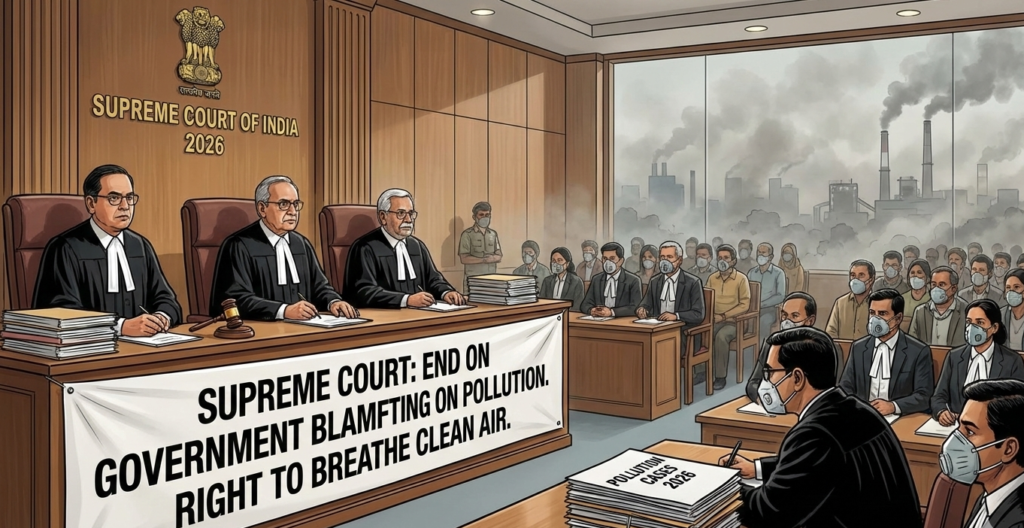
Environmental Justice: Recent hearings suggest the court’s growing impatience with temporary fixes to pollution and environmental degradation. By framing pollution as a right-to-life and public health issue, the judiciary is demanding accountability from institutions that have long escaped serious consequences.
Digital Free Speech: As discourse moves online, challenges to content regulation and laws resembling sedition will test how far the state can go in policing digital expression. The Supreme Court must define the limits of government power in what has become a battleground over tweets, posts, and videos.
A Jurist of Balance and Pragmatism
Justice Kant’s judicial record reveals a nuanced approach that balances constitutional principles with pragmatic governance considerations. He has demonstrated a willingness to check executive overreach, his bench famously stating that the state cannot use national security as a “bugbear” to evade scrutiny. He was part of the bench that halted the operation of the sedition law and granted bail to figures like former Delhi Chief Minister Arvind Kejriwal and fact-checker Mohammed Zubair.
His landmark judgment in the K.A. Najeeb case established that constitutional courts retain the power to grant bail under the Unlawful Activities Prevention Act based on trial delays, despite the statute’s stringent provisions. He’s also championed gender justice, reserving one-third of seats for women in bar associations and reinstating an illegally removed woman sarpanch.
Yet he has also shown deference to government positions on matters of national security and policy, upholding projects like the strategic Char Dham initiative and the One Rank One Pension policy. This duality raises questions about whether his tenure will lean toward judicial assertiveness or deference on contentious constitutional issues.
The Accessibility Imperative
Beyond headline-grabbing constitutional cases, CJI Kant has emphasized making justice accessible to ordinary citizens. His concept of “nyaya on wheels” and strengthening the National Legal Services Authority reflects recognition that justice must travel to the citizen rather than waiting for citizens to struggle toward courtrooms.
Recent infrastructure initiatives including the foundation-laying for ADR buildings, IT facilities, hospitals, and administrative blocks at the Patna High Court demonstrate his commitment to capacity building. He argues that institutional support isn’t peripheral to justice but integral to it, noting that an institution that cares for its people is better equipped to protect the rights and dignity of others.
The Balancing Act Ahead
The challenge facing CJI Surya Kant is unprecedented in scope. He must simultaneously tackle crushing case arrears, restore public trust, resolve polarizing constitutional disputes, and reaffirm the Court’s role as the Republic’s sentinel of liberty, all within a 14-month window.
Some observers worry that the immense administrative burden of the CJI role may temper judicial boldness. The legal community is watching closely to see whether Kant, as “master of the roster,” will fast-track foundational constitutional cases or prioritize administrative efficiency over assertive constitutional protection.
His early actions offer cause for cautious optimism. Within his first week, he signaled intent to list long-pending nine-judge bench matters and addressed the “adjournment culture” that has plagued Indian courts. He’s also navigated sensitive matters with care, recently declining to entertain a PIL challenging the Prime Minister’s ceremonial offerings at the Ajmer Dargah, ruling the matter was not justiciable under Article 32.
A Legacy in the Making
CJI Kant has inherited a court that stands at a historic crossroads. The judiciary’s credibility cannot be assumed, it must be continuously earned through decisions that reflect constitutional fidelity, institutional discipline, and sensitivity to the lived experiences of India’s most vulnerable citizens.
His emphasis on indigenous jurisprudence, mediation, technological modernization, and judicial coherence charts an ambitious reform agenda. Whether these initiatives translate into lasting institutional change or remain rhetorical aspirations will define his legacy.
The stakes extend far beyond courtroom proceedings. The cases awaiting decision in 2026 touch the everyday realities of millions, whether names remain on voter lists, how long accused persons wait for bail, what air children breathe, and how much space exists for dissent in India’s democracy.
As 2026 unfolds, the nation will be watching. But more importantly, the Constitution will be waiting. In the words of one judicial observer, CJI Kant’s tenure may be measured not in years but in direction. If he can set the judiciary on a path of consistency, transparency, accessibility, and constitutionally grounded confidence, he will leave a mark far greater than the calendar allows.
For now, India’s Supreme Court under Justice Surya Kant attempts a difficult balancing act, delivering constitutional clarity while repairing a justice system burdened by delays, backlogs, and the weight of a democracy’s expectations in an increasingly polarized age. The constitutional balancing act has begun, and its outcome will shape Indian jurisprudence for decades to come.

Ishwarya Dhube is a third-year BBA LLB student who combines academic rigor with practical experience gained through multiple legal internships. Her work spans various areas of law, allowing her to develop a comprehensive understanding of legal practice. Ishwarya specializes in legal writing and analysis, bringing both business acumen and hands-on legal experience to her work.
* Views are personal